 Superform
 withdrawals from SuperVault v2 positions require a request followed by an asset claim
Superform withdrawals from SuperVault v2 positions involve requesting redemption, waiting for fulfillment and claiming the released assets. A confirmed request places shares in escrow; fulfillment allocates assets to escrow under the vault's liquidity and accounting constraints. Available liquidity, outstanding strategy debt and protective pauses can affect that process. Legacy v1 positions and third-party vaults may follow different exit routes, so the applicable product and version matter.
· last updated
Liquidity, debt and pause constraints
SuperVault v2 redemptions depend on assets that the strategy can release and a valid vault state for fulfillment. Underlying positions can have limited liquidity, and for SuperStocks strategies that borrow against tokenized stock, releasing collateral can require withdrawing deployed USDC and repaying debt. Market stress or infrastructure disruption can lengthen that process. The borrowing strategy continues to carry liquidation risk while it unwinds. An automated repayment attempt does not ensure that every adjustment finishes before liquidation.
Vault fulfillment also requires usable price-per-share data and an unpaused strategy. Contract checks reject fulfillment when the strategy is paused or its valuation data is stale or expired. Restoring a valid vault state and obtaining available assets are separate requirements for fulfillment. Neither a successful request nor an emergency pause supplies a fixed deadline for receiving tokens.
What determines a redemption's minimum output?
The recorded request price per share (PPS) and the redemption slippage setting constrain a SuperVault v2 fulfillment amount. PPS expresses the value attributed to each vault share, and SuperVault v2 uses a default redemption slippage of 0.5%. The redemption interface also supports an optional slippage setting that constrains execution without fixing the market value of the strategy's assets.
The v2 strategy checks actual redemption output against both a minimum and a maximum. Its lower bound applies the slippage tolerance to the pending shares valued at their recorded request PPS. Its upper bound uses the pending shares and current PPS. If released assets fall outside those bounds, that fulfillment attempt fails. A request confirmation therefore does not lock in the full displayed portfolio value. Market movements and the ability to release sufficient assets within those bounds can affect proceeds and timing.
How does canceling a redemption differ from claiming assets?
Canceling a pending SuperVault v2 redemption seeks the return of shares; an asset claim releases assets after fulfillment. One account can have both pending shares and claimable assets from earlier fulfilled redemptions.
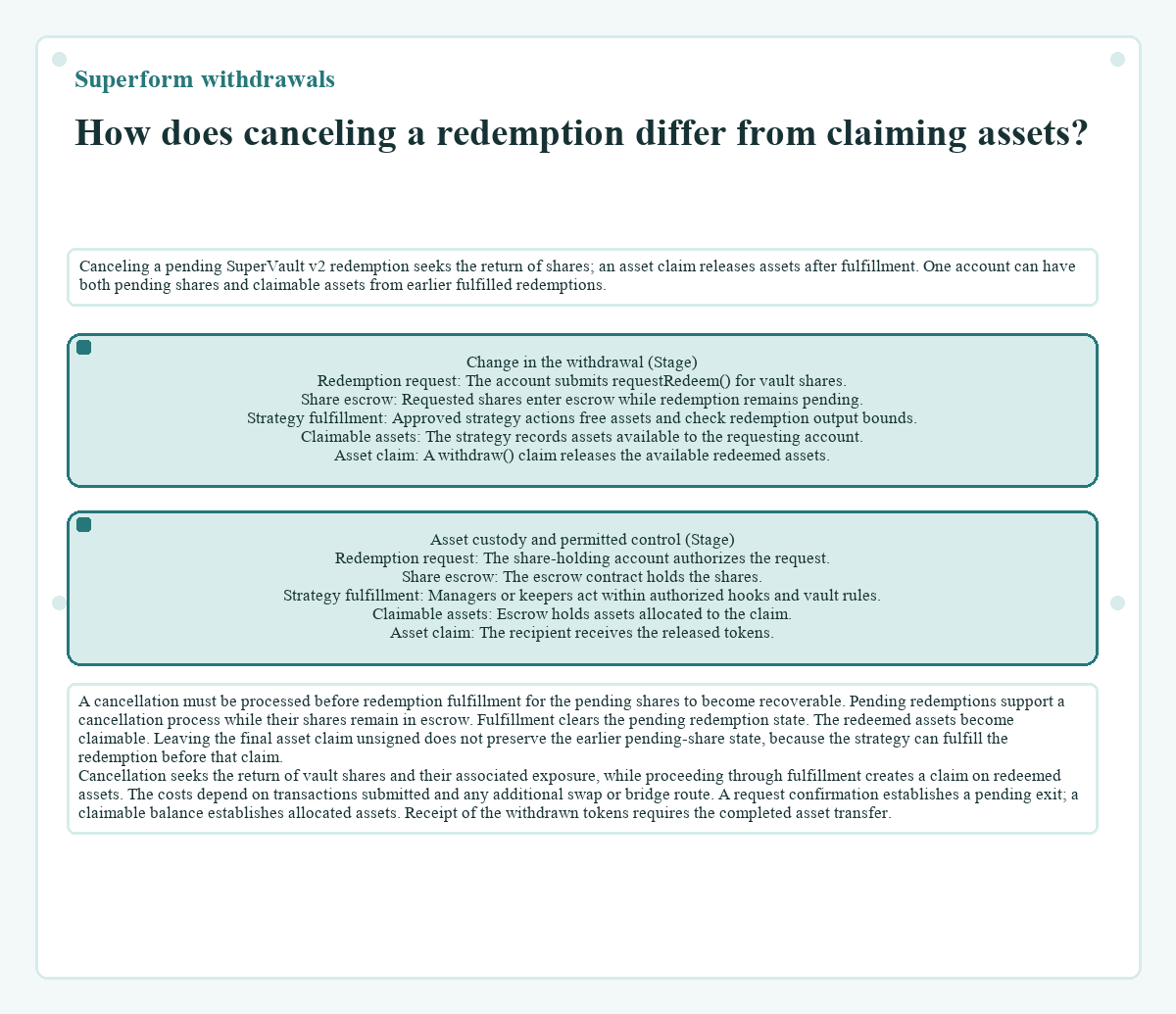
| Stage | Change in the withdrawal | Asset custody and permitted control |
|---|---|---|
| Redemption request | The account submits requestRedeem() for vault shares. | The share-holding account authorizes the request. |
| Share escrow | Requested shares enter escrow while redemption remains pending. | The escrow contract holds the shares. |
| Strategy fulfillment | Approved strategy actions free assets and check redemption output bounds. | Managers or keepers act within authorized hooks and vault rules. |
| Claimable assets | The strategy records assets available to the requesting account. | Escrow holds assets allocated to the claim. |
| Asset claim | A withdraw() claim releases the available redeemed assets. | The recipient receives the released tokens. |
A cancellation must be processed before redemption fulfillment for the pending shares to become recoverable. Pending redemptions support a cancellation process while their shares remain in escrow. Fulfillment clears the pending redemption state. The redeemed assets become claimable. Leaving the final asset claim unsigned does not preserve the earlier pending-share state, because the strategy can fulfill the redemption before that claim.
Cancellation seeks the return of vault shares and their associated exposure, while proceeding through fulfillment creates a claim on redeemed assets. The costs depend on transactions submitted and any additional swap or bridge route. A request confirmation establishes a pending exit; a claimable balance establishes allocated assets. Receipt of the withdrawn tokens requires the completed asset transfer.
Fees reflected in withdrawal proceeds
Withdrawal proceeds reflect investment performance and applicable vault fees. Separate transaction charges depend on the operations used to exit.
The published SuperVault v2 strategy code calculates performance fees from vault-wide PPS growth above its high-water mark, the PPS baseline for fees. Post-fee PPS becomes the next baseline. A performance-fee percentage therefore applies to eligible profit, not the entire withdrawn principal. A configured v2 management fee applies on entry to the vault, reducing the deposited assets credited to the position. The fee configuration matters: a rate published for one SuperStock or curator's vault does not establish the charge for every redemption.
Third-party vaults may impose their own withdrawal charges. Network gas adds transaction costs, while a selected swap or bridge can add app and underlying protocol fees. Claiming vault assets and converting or moving those assets involve different cost inputs. A plain asset claim does not itself establish that the funds have been swapped into another token or delivered to another network.
Which legacy positions migrate instead of withdrawing?
Eligible Superform v1 positions show a Migrate flow that retains their underlying vault shares and makes them accessible in v2.
The underlying vault shares must sit on Ethereum, Base, Optimism, BNB Chain, Polygon, Arbitrum or Avalanche. The chain holding the SuperPosition itself can differ. Eligibility also excludes two-step withdrawal vaults. Moving eligible shares into the v2 app does not redeem them into their underlying assets, so migration alone does not complete an exit to spendable tokens.
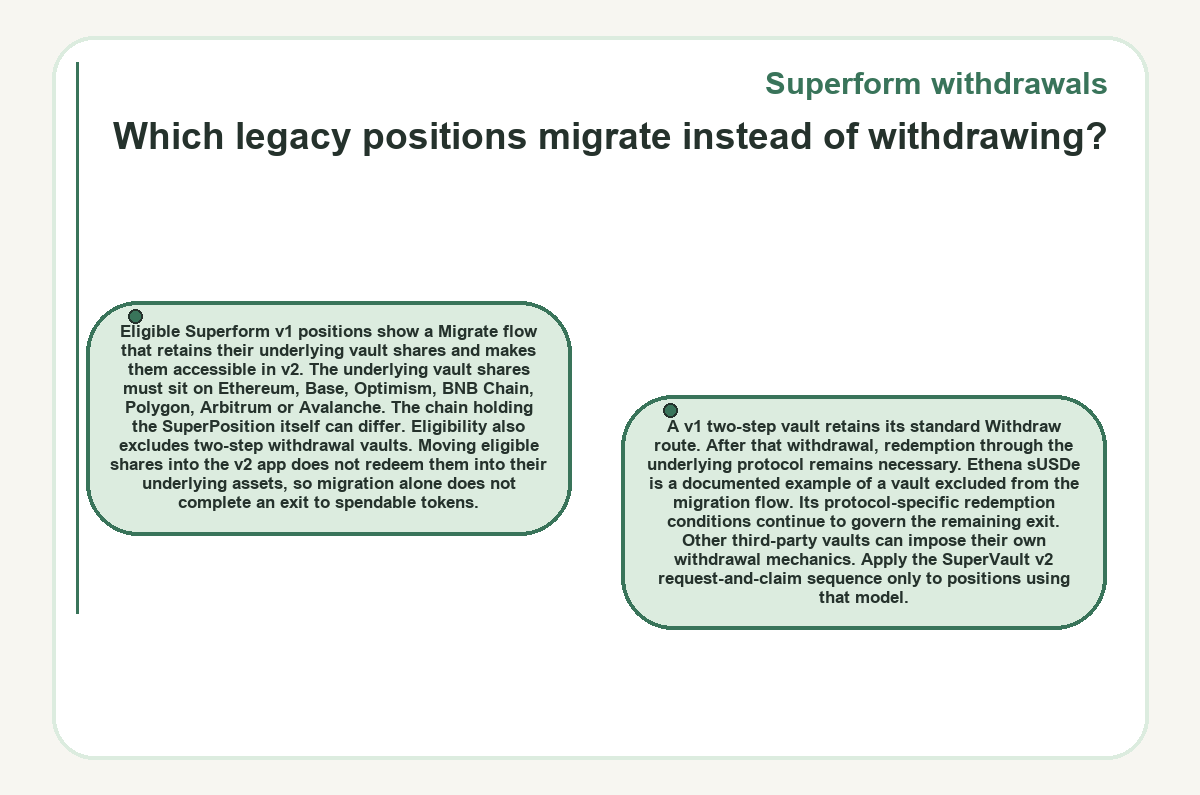
A v1 two-step vault retains its standard Withdraw route. After that withdrawal, redemption through the underlying protocol remains necessary. Ethena sUSDe is a documented example of a vault excluded from the migration flow. Its protocol-specific redemption conditions continue to govern the remaining exit.
Other third-party vaults can impose their own withdrawal mechanics. Apply the SuperVault v2 request-and-claim sequence only to positions using that model.
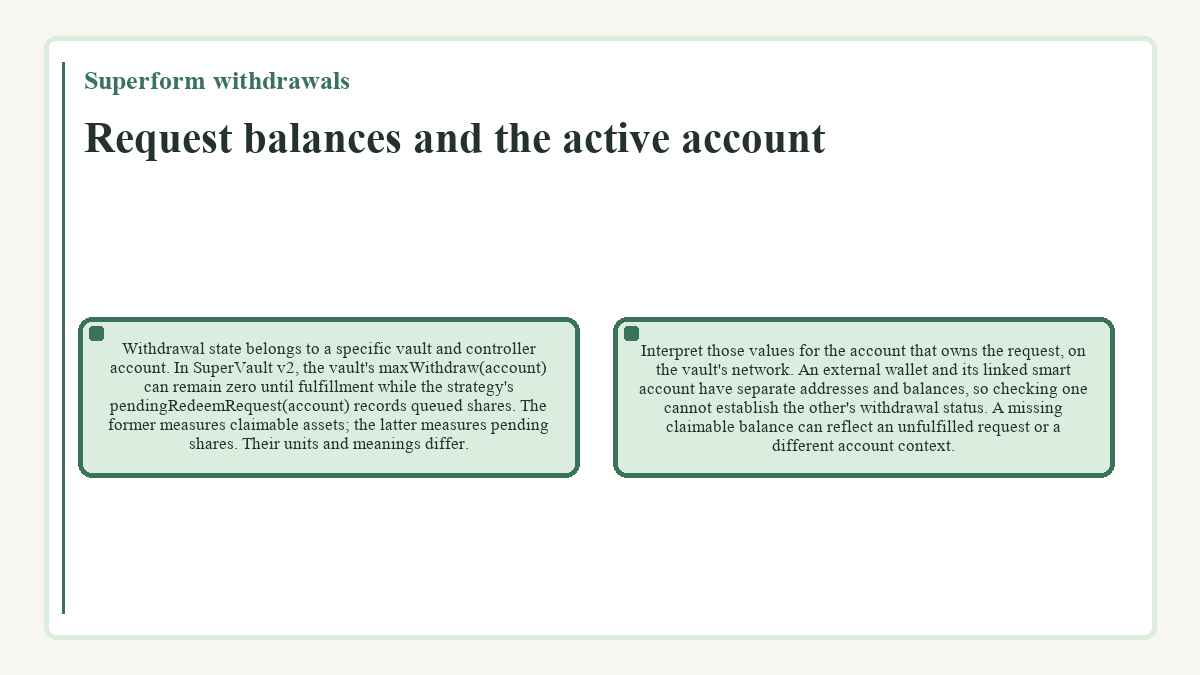
Request balances and the active account
Withdrawal state belongs to a specific vault and controller account. In SuperVault v2, the vault's maxWithdraw(account) can remain zero until fulfillment while the strategy's pendingRedeemRequest(account) records queued shares. The former measures claimable assets; the latter measures pending shares. Their units and meanings differ. Interpret those values for the account that owns the request, on the vault's network. An external wallet and its linked smart account have separate addresses and balances, so checking one cannot establish the other's withdrawal status. A missing claimable balance can reflect an unfulfilled request or a different account context.
Worth knowing
Does submitting a cancellation immediately return escrowed shares?
Submitting a cancellation does not immediately return the shares from a pending SuperVault v2 redemption. The contract tracks a cancellation request separately from the shares that become claimable after cancellation processing. Confirming the request establishes a pending cancellation, while recovery requires cancellation processing to make the shares claimable before redemption fulfillment, followed by the share-return claim.
How does adding shares change an existing redemption request?
Adding shares to a pending SuperVault v2 redemption updates its reference PPS using a share-weighted average. The strategy combines the previous pending shares at their recorded request PPS with the added shares at the current stored PPS, then divides by total pending shares. This keeps the slippage reference tied to both contributions instead of resetting the entire request to the newest PPS.
Will claiming part of a fulfilled redemption remove the rest?
A valid partial claim reduces the SuperVault v2 claimable asset balance only by the amount claimed. The contract checks that the requested assets do not exceed the available claim before subtracting them. Any remaining claimable assets stay recorded for that controller account. This concerns assets from a fulfilled redemption; pending shares have not yet entered that claimable balance.
Is a vault withdrawal also a claim for Merkl rewards?
Merkl-distributed rewards use their own claim flow, separate from the vault's ERC-7540 asset redemption. The integration exposes reward discovery and claim transactions alongside vault redemptions. A completed withdrawal confirms movement of the redeemed vault assets; it does not by itself show that separately claimable Merkl rewards have been collected.
Are v1 migration time estimates also SuperVault v2 withdrawal times?
V1 migration estimates do not set a completion deadline for SuperVault v2 redemptions. For eligible v1 positions, the January 29, 2026 migration instructions estimate a few seconds to a minute when the SuperPosition and underlying shares share a chain. They estimate up to 30 minutes when those chains differ. These timings concern migration; a v2 redemption depends on its own liquidity and fulfillment state.
Does an emergency strategy withdrawal pay each depositor directly?
An emergency strategy withdrawal uses authorized hooks to move positions back through strategy and vault accounting. Individual redemptions remain subject to their request state, PPS checks, output bounds and fee rules. Managers can carry out permitted de-risking actions, and guardians can use pause controls. Expanding the allowed exit actions still requires the applicable hook-authorization process.
Can changing account mode unblock a pending redemption?
Changing between direct wallet and Superform Account modes does not fulfill a pending vault redemption. The mode switch changes the active account; assets stay in the smart account until transferred or withdrawn. A request associated with that smart account continues to depend on the vault's processing state. Switching to the external wallet cannot release strategy collateral or turn pending shares into claimable assets.