 Superform
 SuperVaults combine managed yield strategies with configurable fees
Superform SuperVaults pool assets in ERC-7540 vaults whose operators allocate capital to approved yield sources. Comparing them means examining the deposit asset, permitted strategies, fee basis and liquidity dependencies. Depositors receive shares that represent their vault position. Performance fees apply to eligible profit, while strategy exposure and borrowing can change both returns and exit conditions.
· last updated
A vault's deposit asset does not describe every exposure that its strategy takes. Lending allocations, Pendle Principal Tokens and stock-backed borrowing generate returns through different mechanisms. Their capital flows explain why similar displayed yields can carry different costs and risks.
Deposits and permitted emergency exits
An operating SuperVault accepts its deposit asset and issues shares, then keepers allocate available capital under the configured strategy. A wallet or Superform smart account can hold those shares. Operators direct permitted allocation actions while the assets remain within vault contracts and authorized strategy positions.
If an allocation needs an emergency exit, authorized hooks can move positions back through strategy and vault accounting. Those hooks are contracts that perform specified actions, such as lending or swapping. Recovery remains subject to permissions and accounting constraints. An emergency strategy exit does not itself mean that a depositor has received a withdrawal. SuperVault redemptions are asynchronous, so a comparison also needs to account for the liquidity of the underlying positions.
Lending, Principal Tokens and stock-backed carry
Lending and Principal token allocations
Lending allocations
SuperVaults support ERC-4626 yield sources such as Morpho, Aave wrappers and Euler. Returns depend on the selected underlying markets and the operator's allocation, after applicable costs. The source's own rules remain relevant when a SuperVault holds its shares. Permission sets determine which sources a particular strategy can access.
Principal Token positions
Pendle Principal Tokens (PTs) bought at a discount provide fixed yield when held to maturity, measured in the asset that denominates their principal. That describes the underlying source; vault-level costs and redemption arrangements still shape the depositor's outcome. Selling a PT before maturity can produce a gain or loss, depending on its market price, trading fees and slippage.
Stock collateral and USDC carry
An activated SuperStock strategy can post the corresponding Coinbase Tokenized Stock as collateral in Aave V4's Coinbase Stock Hub on Base. It borrows USDC and supplies that USDC only to approved lending markets. The initial lending destination for the October 2026 rollout was the Clearstar cbAssets Vault on Morpho. Additional borrowing venues require approval. The borrowed funds do not buy more of the stock.
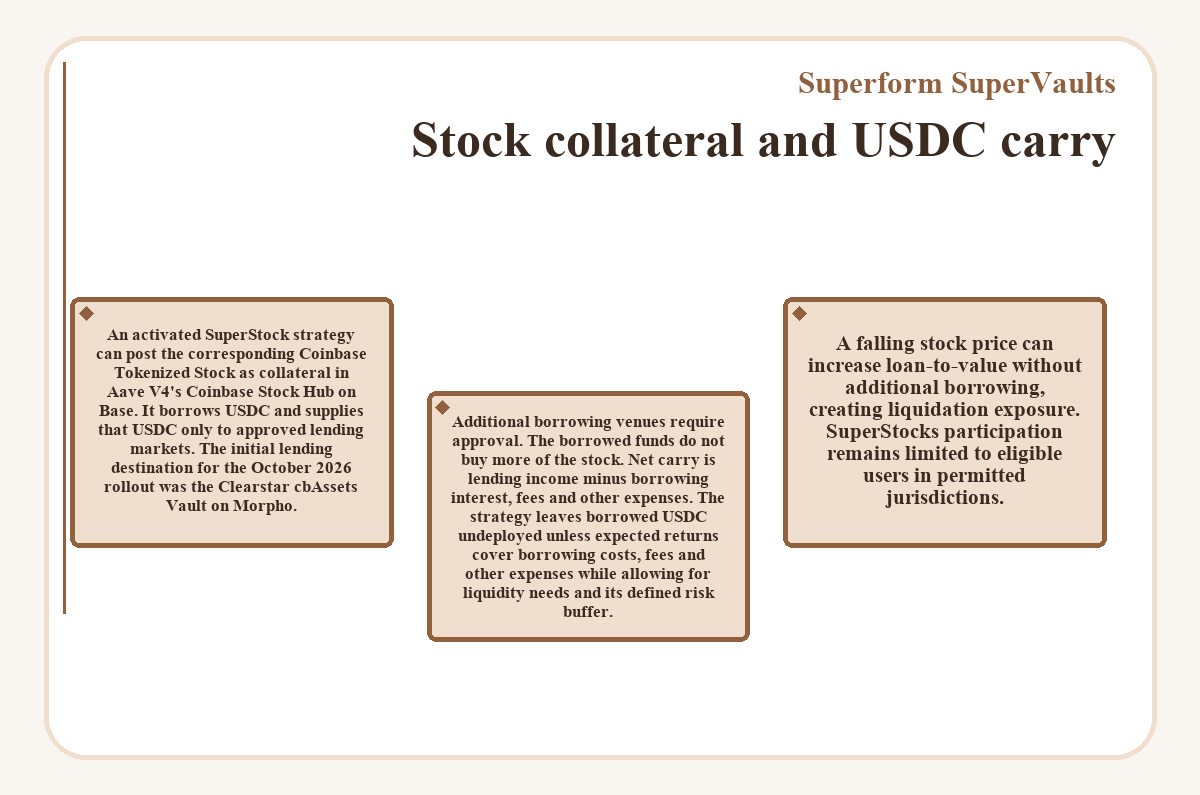
Net carry is lending income minus borrowing interest, fees and other expenses. The strategy leaves borrowed USDC undeployed unless expected returns cover borrowing costs, fees and other expenses while allowing for liquidity needs and its defined risk buffer. A falling stock price can increase loan-to-value without additional borrowing, creating liquidation exposure. SuperStocks participation remains limited to eligible users in permitted jurisdictions.
Fee bases and high-water-mark accounting
A fee's charging basis determines which part of a position bears the cost. A configurable management fee applies to the initial deposit amount. The economics overview describes configurable performance fees on redemption profits above cost basis; the published v2 strategy code implements periodic vault-wide skims. The applicable charges depend on the deployed vault and execution path. These charges have different denominators, so adding their percentages without identifying each base misstates the cost.
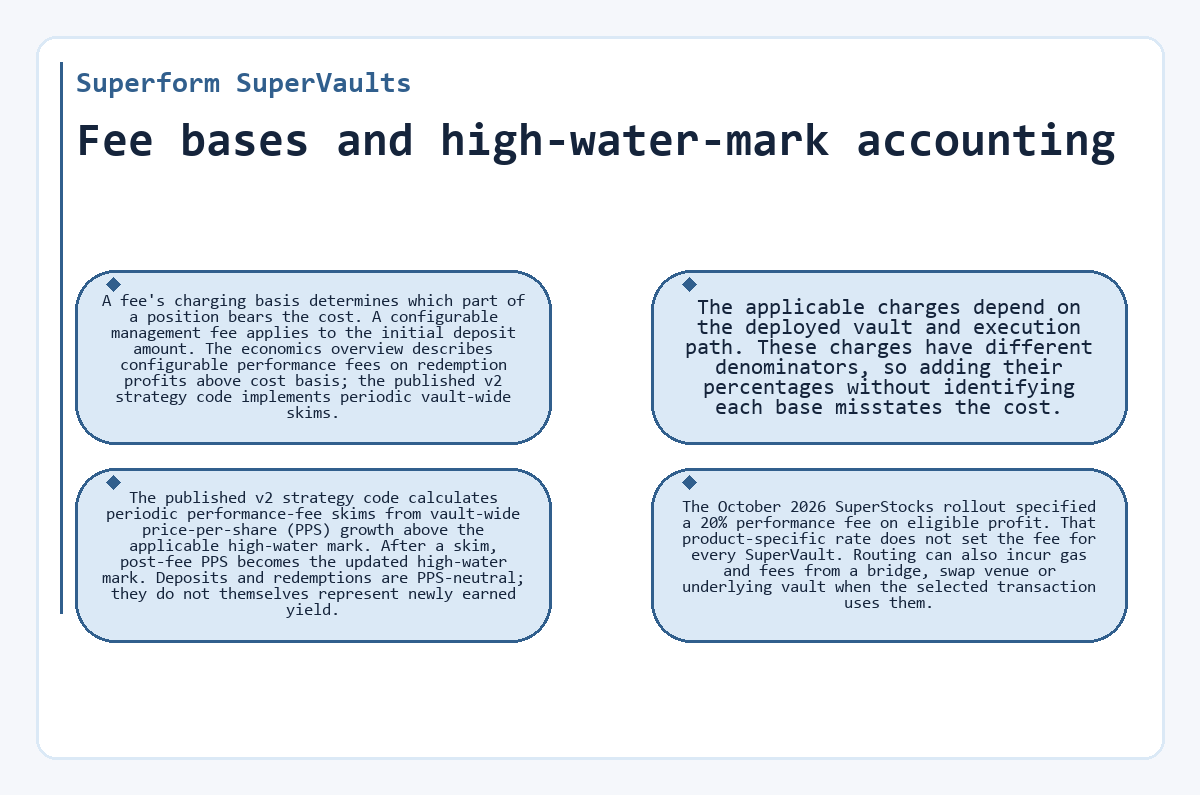
The published v2 strategy code calculates periodic performance-fee skims from vault-wide price-per-share (PPS) growth above the applicable high-water mark. After a skim, post-fee PPS becomes the updated high-water mark. Deposits and redemptions are PPS-neutral; they do not themselves represent newly earned yield.
The October 2026 SuperStocks rollout specified a 20% performance fee on eligible profit. That product-specific rate does not set the fee for every SuperVault. Routing can also incur gas and fees from a bridge, swap venue or underlying vault when the selected transaction uses them.
Strategy income and promotional rewards
A displayed return can include incentives alongside the income that the underlying strategy generates. SuperStocks rewards may include promotional USDC or sUP incentives, separate from lending income after borrowing costs and fees. The market value of sUP rewards can fluctuate. Comparing total returns requires a consistent observation window and clarity about which fees and rewards the displayed figure includes. Two percentages can measure different things when one includes promotional rewards and the other describes lending income alone. A reward programme also does not remove the stock-price or liquidation exposure of the strategy that earns it.
Borrowing rates and lending rates can move independently. SuperformOS can reduce borrowing or unwind a SuperStocks position when its spread becomes unattractive. Automation manages the configured strategy; it does not fix either market rate.
Parameters that constrain strategy execution
Operator discretion ends at the vault's authorized actions and onchain accounting limits. These SuperVault v2 controls govern execution and valuation. Each vault's active onchain configuration supplies its applicable permissions, limits and fees.
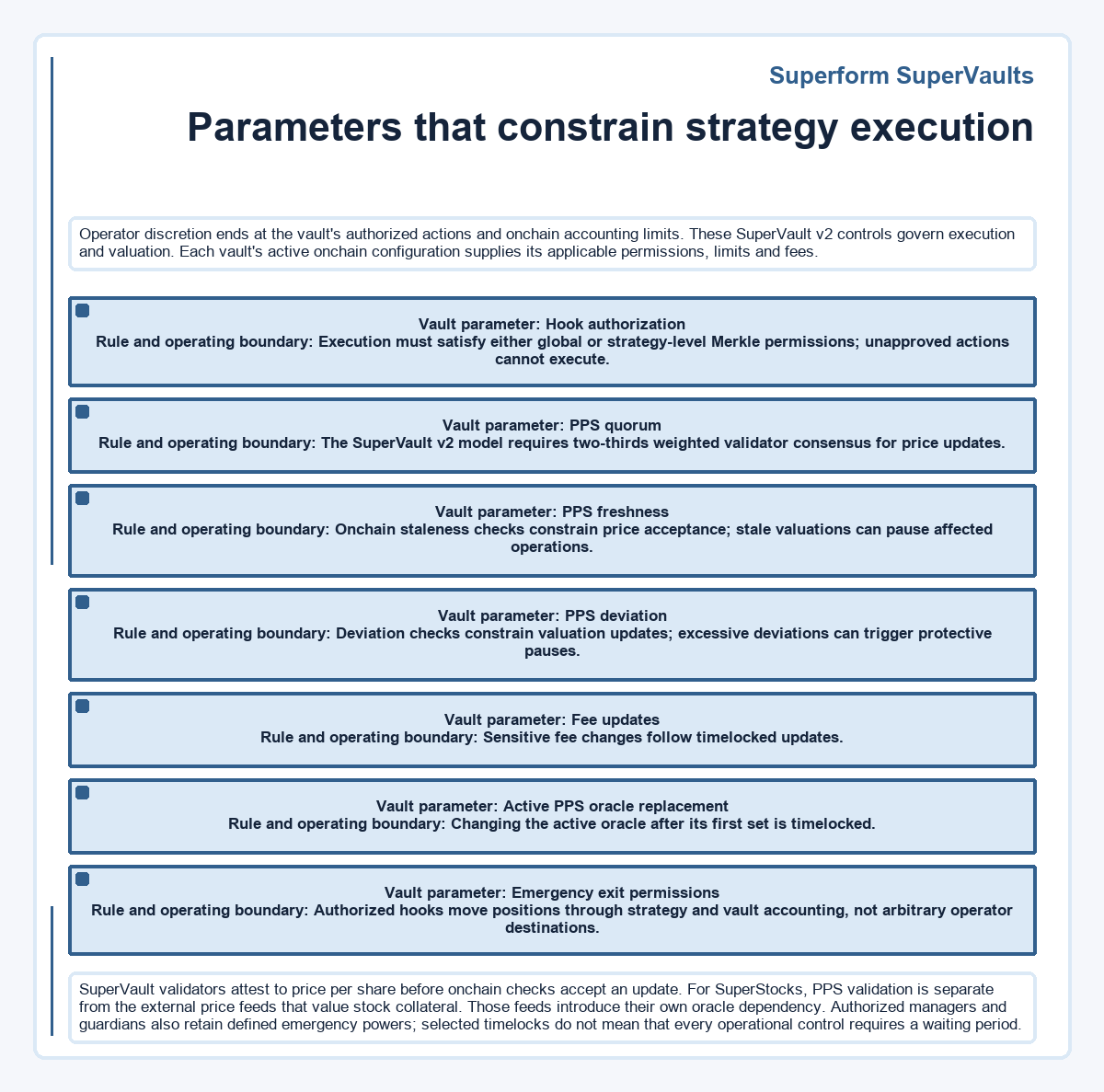
| Vault parameter | Rule and operating boundary |
|---|---|
| Hook authorization | Execution must satisfy either global or strategy-level Merkle permissions; unapproved actions cannot execute. |
| PPS quorum | The SuperVault v2 model requires two-thirds weighted validator consensus for price updates. |
| PPS freshness | Onchain staleness checks constrain price acceptance; stale valuations can pause affected operations. |
| PPS deviation | Deviation checks constrain valuation updates; excessive deviations can trigger protective pauses. |
| Fee updates | Sensitive fee changes follow timelocked updates. |
| Active PPS oracle replacement | Changing the active oracle after its first set is timelocked. |
| Emergency exit permissions | Authorized hooks move positions through strategy and vault accounting, not arbitrary operator destinations. |
SuperVault validators attest to price per share before onchain checks accept an update. For SuperStocks, PPS validation is separate from the external price feeds that value stock collateral. Those feeds introduce their own oracle dependency. Authorized managers and guardians also retain defined emergency powers; selected timelocks do not mean that every operational control requires a waiting period.
The contracts behind a managed vault position
A SuperVault share represents a position in the vault that issues it. Price per share, or PPS, expresses the value attributed to each share after accounting for assets and liabilities. The SuperVault contract holds assets and issues shares, while SuperVaultStrategy manages authorized execution, redemption queues and fee policies. This separation explains why an operator's strategy decisions and a depositor's share balance describe different parts of the same investment.
Escrow holds pending-redemption shares and assets reserved for claims. The SuperVaultAggregator coordinates vault registration, PPS forwarding, upkeep accounting and governor-level constraints. Strategists fund UP upkeep for validator price updates. That operating role differs from the management and performance fees that a depositor compares between vaults.
An underlying ERC-4626 position exposes its holder to that source's rules. A SuperVault position adds manager-selected allocations and SuperVault fee rules to the underlying dependencies. Choosing between them turns on the value of delegated allocation, its permitted scope and its additional costs.
Helpful answers
Which metrics can an app retrieve to compare SuperVault strategies?
Vault discovery data includes APY, total value locked (TVL), rewards and availability for the applicable network. Integrations can also fetch user positions, separating vault-wide figures from account-specific holdings. A quoted annualized return and a user's share balance describe different quantities; neither alone establishes the return that the user has actually realized.
Are ERC-7540 vaults supported as underlying SuperVault yield sources?
SuperVaults support ERC-4626 vaults and Pendle Principal Tokens as yield sources, with asynchronous ERC-7540 source integration on the roadmap. The outer SuperVault already uses ERC-7540 for its own interface. A vault's interface standard and the standards supported by its underlying integrations describe different layers.
Can an allocation strategy evolve without deploying another SuperVault?
A SuperVault's modular hook engine can accommodate strategy changes without redeploying the vault or upgrading the protocol. Existing authorization still bounds what the operator can execute. A strategy that needs broader permissions must follow the relevant authorization update process, including its applicable waiting period.
Is a SuperAsset interchangeable with a SuperVault share?
A SuperAsset is a separate savings token designed to combine positions across multiple SuperVaults, while a SuperVault share represents a position in one vault. Comparing a SuperAsset adds the allocation and rebalancing rules of its constituent vault basket. These are different layers of exposure, even when their names reference a similar underlying asset.
Does moving a v1 position into the v2 app convert it into a SuperVault v2?
Migrating a v1 position makes its retained vault shares available in the v2 app without automatically reallocating them into a SuperVault v2. Reallocation is a separate step. Migration preserves the existing investment; choosing a SuperVault changes the allocation through a separate action and determines which SuperVault rewards may apply.
How does UP upkeep differ from planned SuperVault validator bonding?
Strategists use UP upkeep to pay for validator price updates, while planned validator bonds would secure validator participation. Bonding and slashing belong to later decentralization phases. The current validator program requires permissioned onboarding through Superform.